Rendering
A 2D scene draws unlit until something lights it. Add one light2d and the
whole frame changes meaning: the scene's lights accumulate into a light map
at the camera's resolution, and everything already drawn is multiplied by
that map plus the camera's ambient. Nothing else has to know about it —
sprites, polygons and tile maps are lit without naming a material.
A light
[[nodes]]
id = "n_lamp"
name = "Lamp"
position = [0, 2.5, 0]

[nodes.light2d]
kind = "point"          # point | directional
color = "#ffd28a"
radius = 8.0            # world units; a point light fades to nothing here
intensity = 1.6
shadows = true
The node's position places a light and its rotation aims one: at rest a
light2d shines along −y, and the node's z rotation turns it. A point
light fades quadratically to exactly nothing at radius, so its edge has no
seam. A directional light ignores radius and lights the whole view.
intensity above 1 pushes past white, which is what
bloom picks up.
The ambient it falls to
A scene with no light2d draws exactly as it did before — no extra pass, no
extra draw. The first light changes that: everywhere the lights do not reach
now falls to the camera's ambient, which is black unless you set it.
[nodes.camera]
kind = "2d"
zoom = 60.0
ambient = "#181c22"     # what an unlit surface is multiplied by
That is the knob for the mood of a lit scene. Black ambient is a cave; a dim blue is dusk; white ambient is the unlit look back again.
Occluders and shadows
A shadow-casting light is blocked by any node carrying an occluder2d.
Each occluder edge is extruded away from the light into a polygon, and the
light is masked out wherever those polygons land.
[nodes.occluder2d]
# mesh = "meshes/wall.toml"   # points in order; empty derives the outline
# closed = true               # the last point joins the first
Left empty the outline follows the node's collider2d, and failing that its
circle, capsule, rect or sprite shape — so the thing a player sees is the
thing that casts the shadow, with nothing authored twice. Name a mesh when
you want an outline of your own, or when the node draws a polyline or a
polygon, whose points the engine will not guess at.
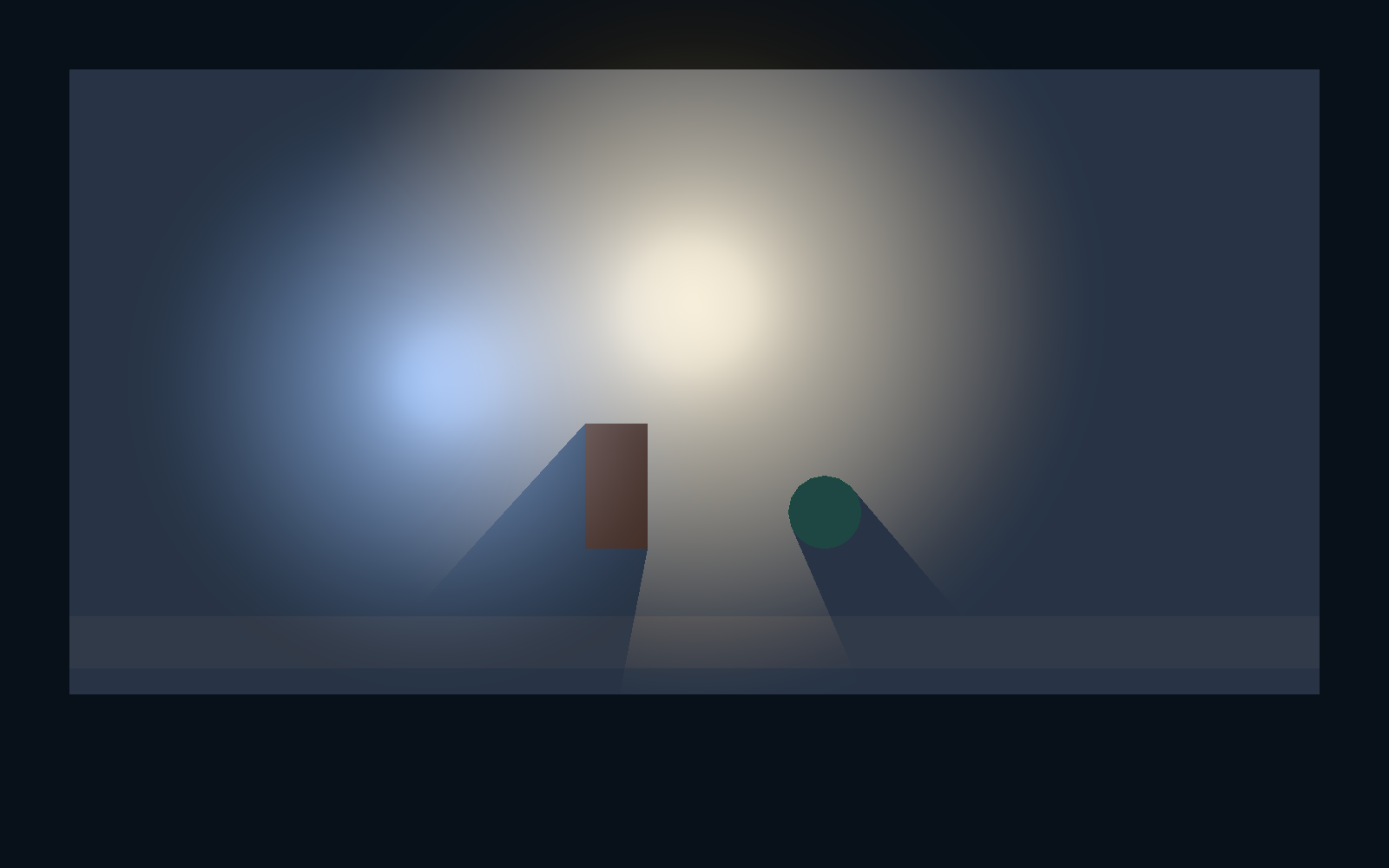
Every edge casts, so an occluder stands in its own shadow. A crate that
should stay lit wants a smaller outline than its sprite, or a light with
shadows = false.
A directional light's shadows are parallel, because its rays are:

Tracing an outline
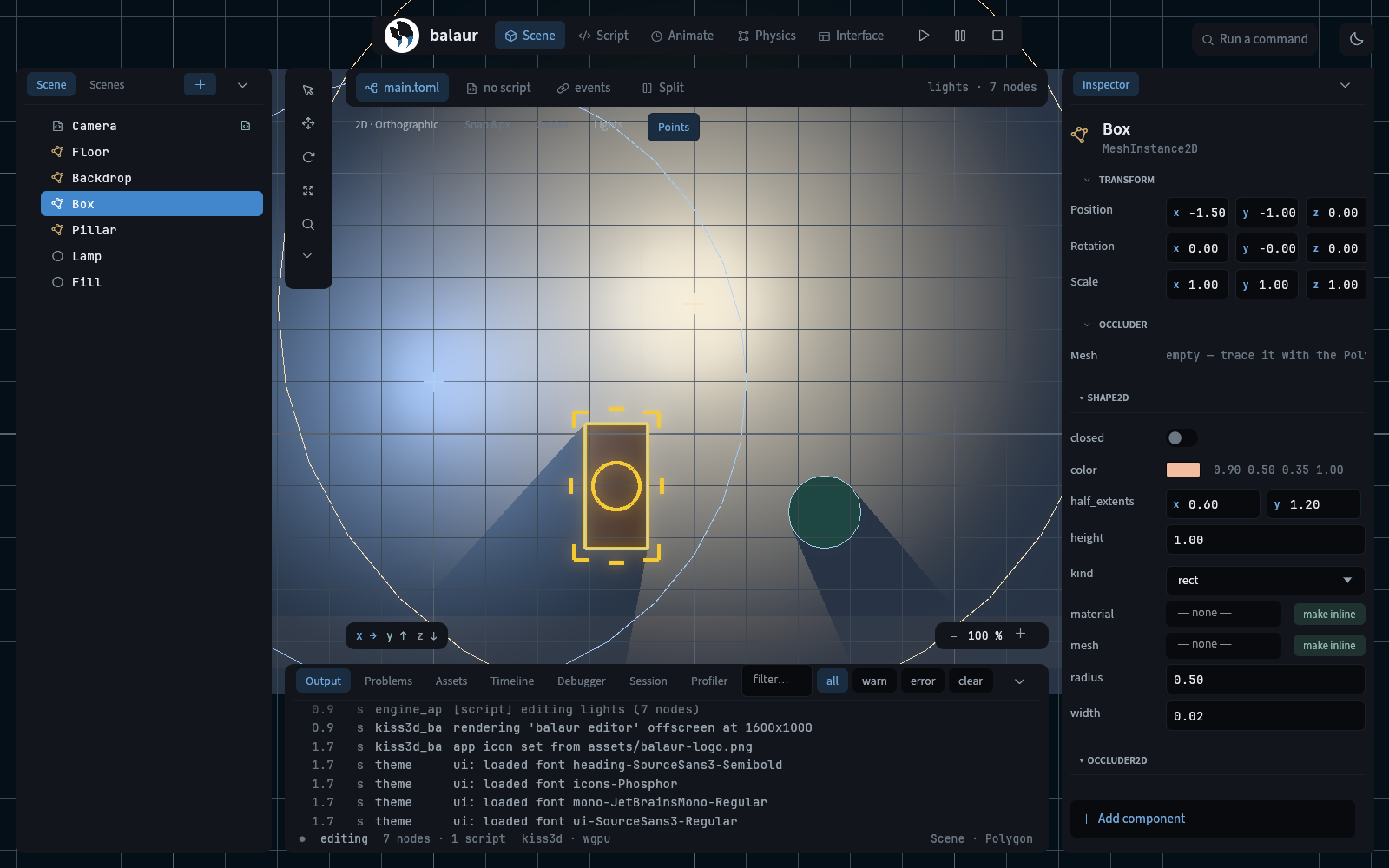
The editor's Polygon tool traces an occluder2d the same way it traces a
polygon, in Points mode — an outline has no triangles, no UVs and no
weights, so those modes are not offered for one. The Lights chip in the Scene
persona draws every light's reach and every occluder's resolved outline, so
a derived one is visible without being written down.
Post-processing
post on the camera names the screen-space effects the frame resolves
through. bloom is the one a lit 2D scene wants — the light map already
gives it bright pixels to bleed:
[nodes.camera]
kind = "2d"
post = ["bloom"]
bloom_threshold = 0.9   # brightness a pixel has to pass
bloom_intensity = 0.7   # how much is added back
ssao, ssr and dof are the other three, and they are 3D only. Unlike
ambient, post is not per-dimension: the effects run over the whole film,
so the last current camera of either kind sets them.
What the light map reaches
The multiply lands on everything already drawn — sprites, polygons, tile maps, and a 3D scene sitting under a 2D one. Debug lines and particles draw after it and stay unlit, which is usually what you want from a debug overlay and worth knowing about a particle effect.
Lights are an observer, like the rest of rendering: they never touch the simulation, so a lit game and a headless one tick identically.
Limits
A frame draws at most 64 lights, and each shadow-casting light costs a pass of its own. A scene past that is told once in the log rather than quietly dropping frames.