Rune scripting
· 2 min read
Rune scripts. Every subsystem declares its bindings once, against a seam with no language in it, so a second language cost the engine nothing.
What landed
- The seam.
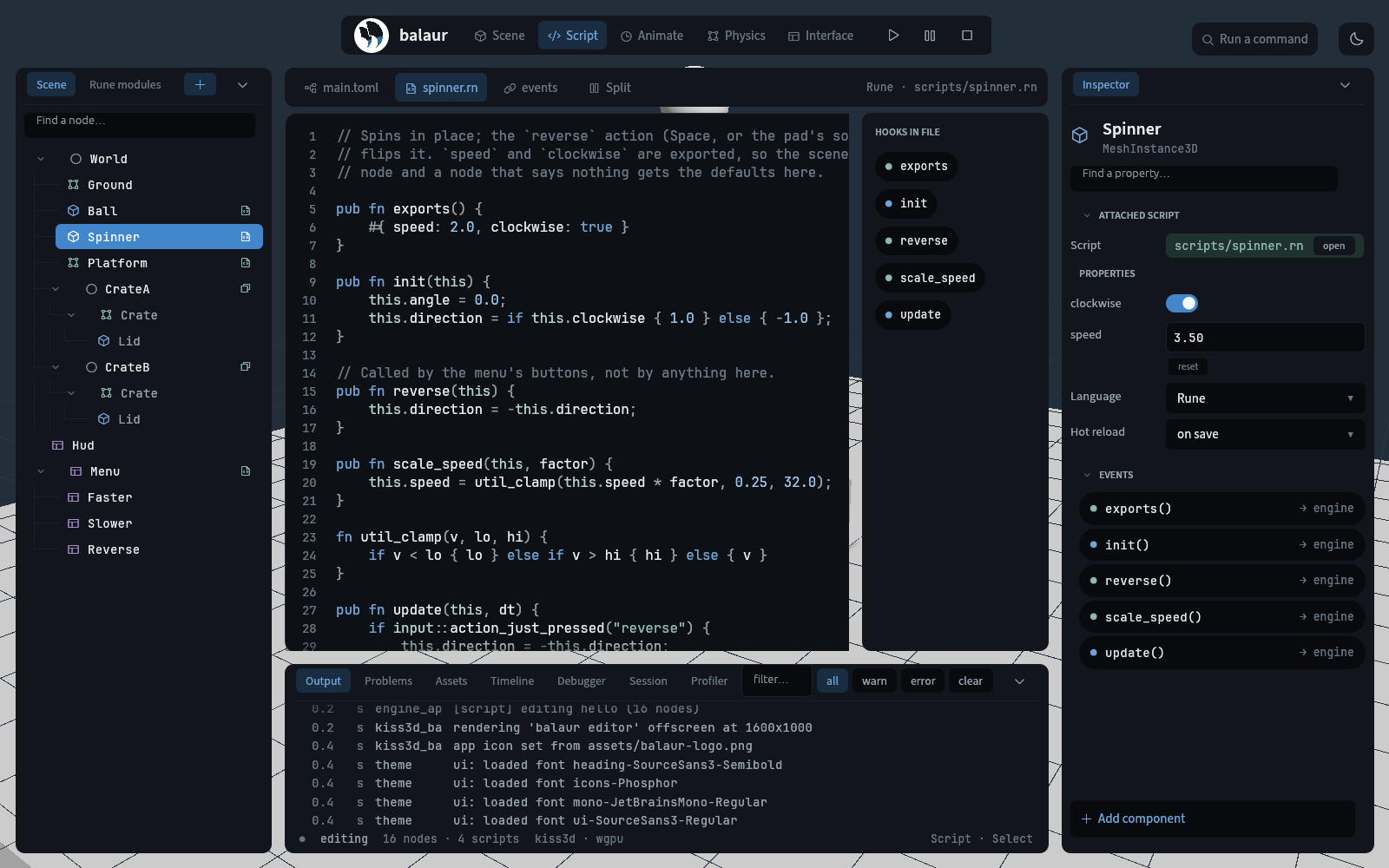
balaur_scriptis the neutral contract: a binding is a name, typed values and a function. A backend implementsScriptHostagainst it. Physics, input, render, audio and UI declare their bindings there and know no language. - Rune.
balaur_script_runeis the host, picked bylanguageinproject.toml. One object per node,pub fn update(this, dt), and what a script writes tothisis what the host reads next frame. Rune reads like Rust without types. - The node API, once. Twenty-seven node operations are one list of neutral functions taking the node first. A backend adds only its call sugar; a third language would cost the sugar, not the operations.
- Exported properties.
pub fn exports()returns defaults; the scene overrides only what it changes; the inspector lists them per node. - Component handles. Each component a node carries is a field on the
node, and the field's methods are the driving module's functions with the
node filled in.
get(),set(table),has()andremove()on all of them.
pub fn exports() {
    #{ speed: 2.0 }
}

pub fn fixed_update(this, dt) {
    // physics2d::apply_impulse(this.node, ...), spelled from the node
    this.node.body2d.apply_impulse(this.speed * dt, 0.0);
}
Luau was the first host and Rune the second; a few days on, Rune is the only one. Scripting has the model.